
Rigaku SmartLab SE (Cobalt-source) Powder XRD
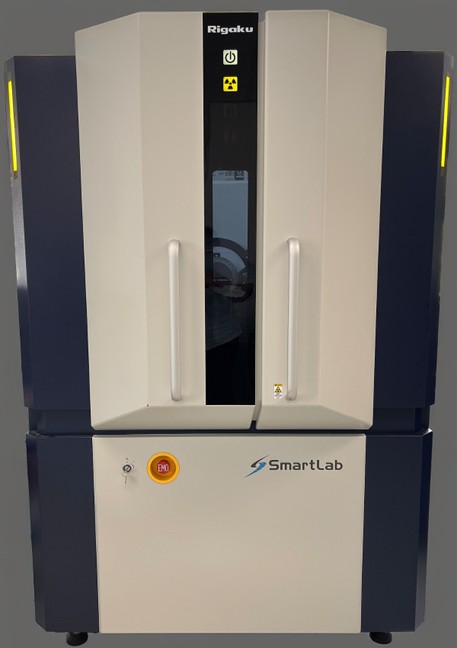
Instrument ID: https://doi.org/10.48610/5c4bb56
Description
The Rigaku SmartLab SE (Cobalt-source) Powder XRD is used for powder diffraction analysis of samples that contain high concentrations of iron. Cobalt radiation is preferred for such samples because it does not induce fluorescence. X-Ray fluorescence results in a high background for the diffraction trace, lower signal to noise ratio and smaller depth of penetration for the X-Rays.
The amount of fluorescence that occurs depends on the combination of the X-Ray target and the material analysed. X-Rays have a characteristic radiation with peaks at different wavelengths depending on the source material. The wavelength of these peaks determines the depth of penetration, absorption and scattering of the X-Rays. To ensure optimal scattering, the wavelength of the Kα radiation peak of the target should be longer than the K absorption edge of the sample material. For this reason, a cobalt source is preferred over a copper source when analysing samples with high concentrations of iron.
| X-ray Source | Wavelength of Ka (Å) |
| Cobalt | 1.790 |
| Copper | 1.542 |
| Material to be analysed | K absorption edge (Å) |
| Iron | 1.743 |
The instrument’s specifications are:
- Geometry: Bragg Brentano Geometry
- Source: Co anode, sealed, 3kW
- Detector: D/teX Ultra 250 silicon strip detector
- Conditions: Atmosphere
- Setup: Powder Diffraction, 6 Position Auto Changer
- Analysis package: DiffracPlus EVA, TOPAS, Siroquant V4
Is this the right instrument for you?
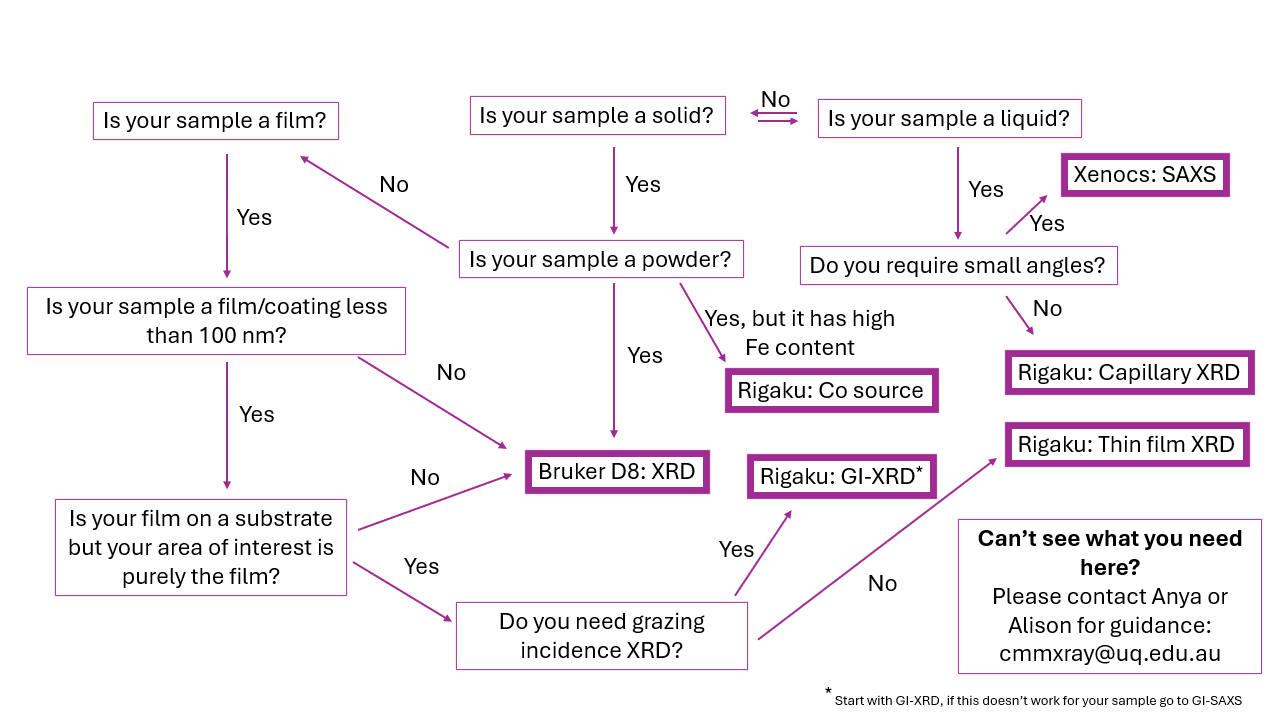
Use this flowchart to determine if the Rigaku Smartlab is the right instrument for your samples. If it is not, links to our other instruments can be found on the X-ray lab home page.
Location: Chemistry Building
Contact: Anya Yago; a.yago@uq.edu.au
Links:
Powder XRD Sample submission form
Sample Identification Label - Large
Sample Identification Label - Small