
| Intermediate to advanced level Prerequisites include:
|
|
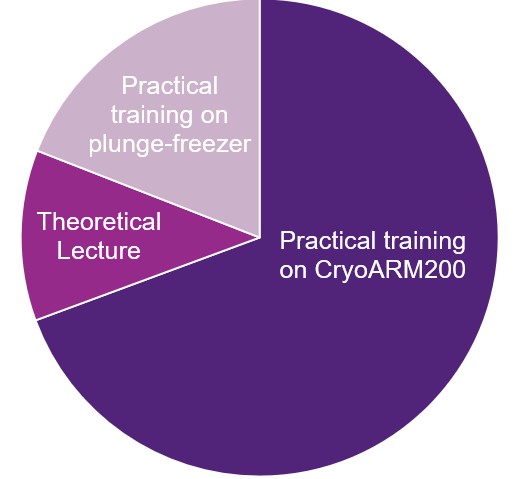
| Approx. 18 hours to complete Theoretical lecture – 45 min | |
| Available on monthly basis (training dates) |


Learning Objectives
What will you learn?
- Understand the fundamentals of sample vitrification for cryoEM.
- Methods to plunge-freeze your sample.
- Operate high resolution microscopes with advanced software.
- Image your sample at high-resolution to get structural insights.
Is this the right course for you?
- This course is aimed at TEM users that have optimised their samples under conventional TEMs but now need a better understanding of their samples in near native conditions.
- You have mastered the JEOL 1400 Flash. You're ready for the full cryoARM experience. These microscopes will require you to give your best, but we are here to help you face that challenge.
If you are unsure about this course, contact Lou Brillault to discuss options CMM offers to analysie your sample for cryoEM. We can tailor approaches for your project.
Course Format
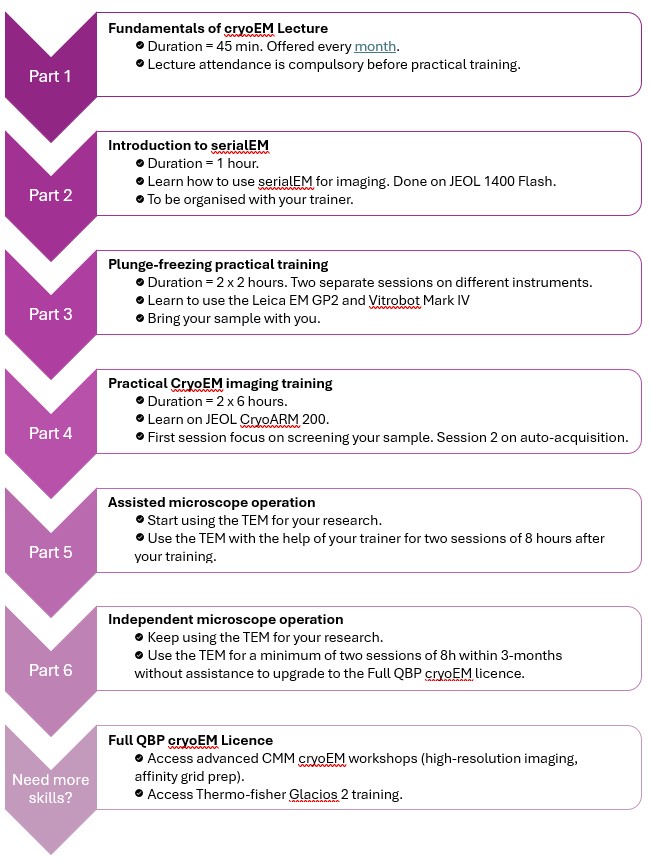
Part 1: CryoEM Introduction Lecture
Location: QBP (Bldg 80) — Please see dates online
Duration: 45 mins – 1 hour (Offered monthly)
We invite you to join an engaging lecture covering the theoretical foundations of cryo-Electron Microscopy (cryoEM).
- What we cover: We will explore the vitrification of aqueous specimens, the different types of cryoEM grids, and the specifics of imaging frozen-hydrated samples. We will also dive into the hardware, including Field-emission guns (FEG), energy filters, and direct-electron detectors, as well as common challenges you might face.
- Discussion: Afterwards, we’ll discuss your specific project and the unique requirement of your samples.
Part 2: Introduction to SerialEM
Location: QBP (Bldg 80), Level 2 East, Room 2.150
Duration: 1 hour (Offered monthly)
Held on the JEOL 1400 Flash, this session introduces you to the SerialEM interface and how to use this software to operate the microscope effectively.
- Recommendation: To get the most out of your experience, we strongly suggest completing this module at least two weeks before you start your practical cryoEM training (Part 4).
Part 3: Sample Preparation for CryoEM
Location: QBP (Bldg 80), Level 2 East, Room 2.150
Duration: 2 sessions x 2 hours each (Offered monthly)
This hands-on module is designed for small groups (maximum of 3 participants) to ensure safety and confidence.
- Session 1: Focus on using the Leica EM GP2 to plunge-freeze your sample. We will cover essential safety protocols for handling liquid nitrogen and condensed ethane.
- Session 2: You will learn to operate the Vitrobot Mark IV. Experiencing both devices will help you decide which option is best suited for your specific samples.
Bring your own sample: We highly recommend bringing a sample to these sessions. If you are unsure if your sample is ready or of sufficient quality, please chat with Lou Brillault before your training date.
Part 4: Practical CryoEM Image Training
Location: QBP (Bldg 80), Level 2 East, Room 2.150
Schedule:
- Day 1: 10:30 am – 4:00 pm
- Day 2: 10:30 am – 4:00 pm
- Offered monthly
This intensive practical block runs over two days. With a small group size (maximum of 3), you will receive plenty of personalised guidance as you learn to image your samples.
Parts 5 & 6: Assisted and Independent Operation
Building your Expertise during your three-month provisional licence period, the goal is to consolidate your training. To achieve this, you are required to complete the following sessions:
- Two assisted sessions (8 hours each) with your trainer.
- Two independent sessions (8 hours each) working on your own.
What happens if I can't complete the sessions?
If you haven't returned within three months or haven't quite managed to finish the required number of sessions, you will need to repeat the competency test during an assisted session. Please note that training credits will apply to this session. This isn't a penalty; it is simply to ensure you remain safe and confident on the instrument.
Unlocking the full licence once you have completed your required assisted and independent sessions, you will be upgraded to the full QBP cryoEM licence. This is a major milestone that grants you:
- Access to the cryoARM 300.
- Eligibility for Thermofisher Glacios 2 training.
- Eligibility for the different advanced workshops organised throughout the year.
Licence Maintenance
To keep your licence active, you must use the microscope at least once every 3 months. If you lapse for a period of more than 3 months, you will need to complete the cryoEM competency assessment again to get back up and running.
Training Credit
If you are undertaking the CryoEM course you will be asked to commit to a training and skills enhancement fee of $350. The credit will include two assisted sessions of 8 hours of instrument access time and can be used for your research project or enhance your knowledge. The credit is available for 3 months from your cryoEM training and is not transferable to other users or techniques. Any questions on the training course fee contact cmm@uq.edu.au.
Timetable 2026
| Introduction to TEM for biological samples | Practical course dates |
| 1 | 2-3 February |
| 2 | 2-3 March |
| 3 | 1-2 June |
| 4 | 6-7 July |
| 5 | 3-4 August |
| 6 | 7-8 September |
| 7 | 5-6 October |
| 8 | 2-3 November |
| CryoEm Course | cryoEM Lecture dates | SerialEM Introduction dates | Plunge-freezing practical course dates |
| 1 | 12 January | - | 13-14 January |
| 2 | 9 February | 6 February | 10-12 February |
| 3 | 9 March | 6 March | 10-12 March |
| 4 | 11 May | 8 May | 12-14 May |
| 5 | 8 June | 5 June | 9-11 June |
| 6 | 13 July | 10 July | 14-16 July |
| 7 | 10 August | 7 August | 11-13 August |
| 8 | 14 September | 11 September | 15-17 September |
| 9 | 12 October | 9 October | 13-15 October |
| 10 | 9 November | 6 November | 10-13 November |
| CryoEM Imaging Practical Course | Dates |
| 1 | 20-22 January |
| 2 | 17-19 February |
| 3 | 17-19 March |
| 4 | 18-19 May |
| 5 | 16-18 June |
| 6 | 21-23 July |
| 7 | 18-20 August |
| 8 | 22-24 September |
| 9 | 20-22 October |
| 10 | 17-19 November |