
"Welcome to CMM’s TEM and cryoEM training program. Our goal is to support you in confidently acquiring high-quality structural data, with hands-on training, expert guidance, and a clear pathway to independent operation."
Roger Wepf
CMM Director
Understand the structural insights of your samples by learning Transmission Electron Microscopy (TEM) and cryo-electron microscopy (cryoEM).
Designed for structural biologists, this course offers a comprehensive introduction to TEM. It is divided into two modules: the first covers TEM using room temperature techniques, while the second course focuses on cryoEM applications and advanced methods for observing samples embedded in vitreous ice.
Introduction to TEM of biological samples
| Beginner Level No prior experience necessary |
|
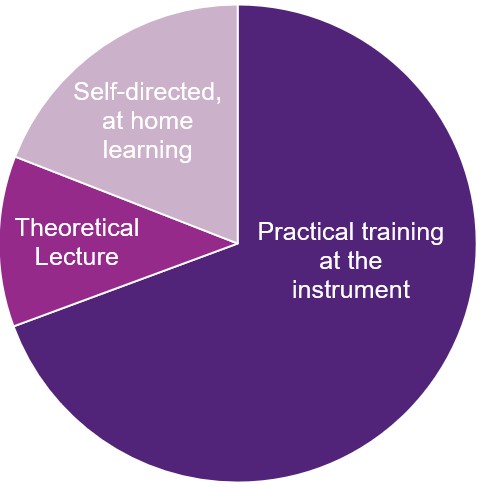
| Approx. 8.5 hours to complete Theoretical lecture – 1 hour | |
| Available on monthly basis (training dates) |

Learning Objectives
What will you learn?
- Understanding the fundamentals of TEM.
- How to prepare TEM grids with your samples.
- How to operate the JEOL 1400 Flash at a basic level.
Is this the right course for you?
- Your research needs high-resolution structural data: This course is the pre-cursor of our more advanced cryoEM course, here you will learn how to use a TEM to see the details of your sample.
- Your samples are ready to be analysed under TEM: Mastering TEM requires significant commitment. While we provide comprehensive training, achieving rapid independence relies on consistent practice. To maximize your sessions and use the microscope frequently, it is essential to have your samples prepared in advance.
- You have no or little experience in TEM: Then this course is for you! You will receive the theoretical and practical background required to operate a TEM with confidence, just bring your samples and we will go from there. If you are unsure contact Lou Brillault to discuss the different options CMM offers to analyse your sample.
Course format
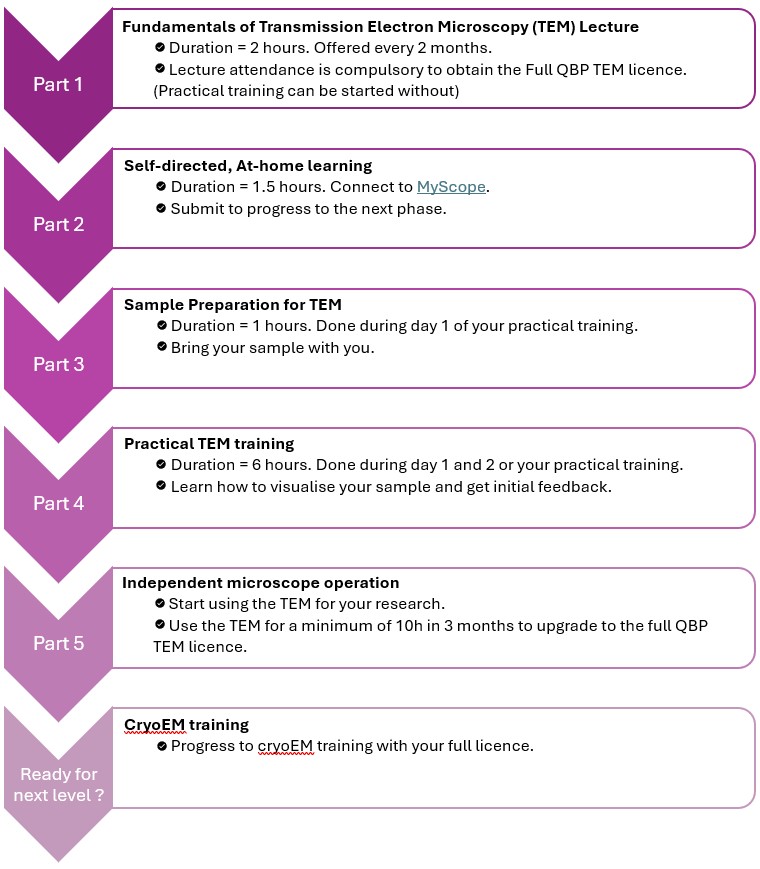
Part 1: TEM Introduction Lecture
Location: AIBN (Bldg 75), Level 1 Seminar Room Time: Friday, 9:00 am – 11:00 am (Offered every two months).
We invite you to a lecture covering the theory and essential operation of the TEM. We will explore the electron and its properties, electron–matter interactions, and the instrument's core systems - including the illumination system (electron guns, electromagnetic lenses, apertures), the imaging system, and contrast mechanisms. Following the lecture, we’ll open a discussion. This is a great opportunity for new clients to chat about their specific projects, requirements, and expectations.
Part 2: Self-directed, at-home learning
Duration: Approximately 1.5 hours
To prepare you for the practical sessions, we provide learning materials that you can work through at your own pace. Please ensure these are finalised before you begin Part 3. This module includes a short quiz to help check your understanding of the lecture material.
Tip: Feel free to check out the MyScope TEM module online to get a head start!
Part 3: Sample Preparation for TEM
Focus: Hands-on preparation skills
On your first day of training, we will show you how to transfer your samples onto TEM grids and dehydrate them for visualisation under the electron beam. To give yourself the best chance of observing your sample clearly, please ensure it is well-purified. If you are unsure about the quality of your sample or how best to purify it for TEM applications, please contact Lou Brillault to discuss your options.
Part 4: Practical TEM Training
Location: QBP (Bldg 80), Level 2 East Room 2.150
Schedule:
• Day 1: 10:30 am – 4:00 pm
• Day 2: 10:30 am – 12:30 pm
• Please see available dates. Offered monthly.
This practical training is held in small groups (maximum of three participants) to ensure you get plenty of support. Over two days (6 hours total), your trainer will guide you through the steps to observe your samples, allowing you to practise under supervision.
To wrap up the training, you will demonstrate your new skills during a 20-minute competency check at the end of Day 2.
- Success: If you successfully demonstrate your ability to operate the TEM, you will receive a three-month provisional TEM licence.
- Support: If your trainer feels you need a bit more practice after the initial session, we will happily arrange extra training to help you get there.
Part 5: Independent Microscope Operation
Building Your Confidence
Once you have secured your three-month provisional licence, it is time to build your experience. To ensure you truly master the instrument, we require you to log a minimum of 10 hours of independent microscope use within this three-month period.
What if I can't complete the hours?
We understand that schedules can get busy. If you are not able to return within three months, or if you complete fewer than 10 hours, you will need to repeat the competency test during an assisted session. This isn't a penalty; it is simply to ensure you have consolidated your skills and remain safe and confident on the machine. Please note that training credits will apply to this session.
Ready for the Next Level?
Upgrade to a Full Licence
This is where your hard work pays off! Once you have completed your 10 hours of independent use, you will be upgraded to the full TEM licence. This unlocks two major benefits:
- After-hours access to the JEOL 1400 Flash.
- Eligibility to enrol in our advanced cryoEM training.
Maintaining Your Licence
TEM operation is a skill that requires regular practice. To keep your full licence active, you need to use the microscope at least once every three months. If your usage lapses for more than three months, your licence will be suspended, and you will need to complete the competency assessment again to get back up and running.
Training Credit
If you are undertaking the Introduction to TEM of Biological Samples course you will be asked to commit to a training and skills enhancement fee of $350. The credit will include 10 hours of instrument access time and can be used for your research project or enhance your knowledge. The credit is available for 3 months from your initial training and is not transferable to other users or techniques. Any questions on the training course fee contact cmm@uq.edu.au.
Timetable 2026
| Introduction to TEM for biological samples | Practical course dates |
| 1 | 2-3 February |
| 2 | 2-3 March |
| 3 | 1-2 June |
| 4 | 6-7 July |
| 5 | 3-4 August |
| 6 | 7-8 September |
| 7 | 5-6 October |
| 8 | 2-3 November |
| CryoEm Course | cryoEM Lecture dates | SerialEM Introduction dates | Plunge-freezing practical course dates |
| 1 | 12 January | - | 13-14 January |
| 2 | 9 February | 6 February | 10-12 February |
| 3 | 9 March | 6 March | 10-12 March |
| 4 | 11 May | 8 May | 12-14 May |
| 5 | 8 June | 5 June | 9-11 June |
| 6 | 13 July | 10 July | 14-16 July |
| 7 | 10 August | 7 August | 11-13 August |
| 8 | 14 September | 11 September | 15-17 September |
| 9 | 12 October | 9 October | 13-15 October |
| 10 | 9 November | 6 November | 10-13 November |
| CryoEM Imaging Practical Course | Dates |
| 1 | 20-22 January |
| 2 | 17-19 February |
| 3 | 17-19 March |
| 4 | 18-19 May |
| 5 | 16-18 June |
| 6 | 21-23 July |
| 7 | 18-20 August |
| 8 | 22-24 September |
| 9 | 20-22 October |
| 10 | 17-19 November |