
The EarthBank Project
The AuScope EarthBank platform is a geospatial repository designed for easily visualising, analysing, and extracting georeferenced data produced from various geochemistry labs across the world. It is a free and open-access, cloud-based platform for storing and analysing geochemical datasets that aims to provide the global scientific community with access to a Findable, Accessible, Interoperable, and Reusable (FAIR) data repository that is augmented with additional visualisation and analytical tools to help interpret these large and complex datasets. This enables the EarthBank platform to go beyond being a simple data repository, facilitating EarthBank users with a powerful multi-purpose geochemical research tool. EarthBank supports the upload of a wide variety of data types from across various fields of geoscience and minerals research, ranging from whole-rock and trace element geochemistry, mineral maps, EPMA, fission track, LA-ICP-MS and SIMS U-Pb geochronology, and Ar-Ar geochronology with several more isotopic packages currently in development (e.g., Lu-Hf, Sm-Nd, O, Sr, Hf etc.). Users can explore these datasets in a map-based view (similar to Google Earth) to visualise and download data packages relevant to their research projects. EarthBank also has the capacity to seamlessly mint both DOIs for uploaded data packages and International Generic Sample Number (IGSN), which are unique identifiers for physical samples and specimens. DOI and IGSN registrations facilitate the identification of samples in the literature, and preservation and ease of access to physical samples and sample data for ongoing research.
Please join one of the upcoming EarthBank Workshop to learn more about this ongoing project. Additional details and video tutorials outlining the scope and aims of the EarthBank initiative can be found at: https://www.auscope.org.au/earthbank
| Beginner Level No prior experience is required for this course. Viewing of EarthBank tutorials is recommended to ensure familiarity with course content prior to attendance. |
| Approx. 2 hours for completion
|
| Available on a fortnightly basis at St. Lucia campus (workshop dates).
|



Learning Objectives
What will you learn?
- Understand the goals and aims of the AuScope EarthBank project.
- Become familiar with navigating the platform, platform capabilities, and the criteria needed to become a contributor to a FAIR data repository.
- Learn how to visualise and interpret global geochemical datasets using the tools incorporated into the EarthBank platform.
- Become familiar with the workflows required to standardise and upload geochemical datasets to the EarthBank repository.
Is this course for you?
- This course is designed for geoscientists and those involved in minerals research who generate a wide variety of geochemical datasets.
- The workshop is free and open to all geoscience and mineral researchers who are interested in contributing their research datasets to the EarthBank repository, or those interested in collating data from a global open-access database to contribute to their own research projects.
- No prior experience with, or knowledge of, the AuScope EarthBank initiative is necessary for this workshop. Viewing of the EarthBank tutorials is highly encouraged prior to attending the workshop. These can be found here.
Course format
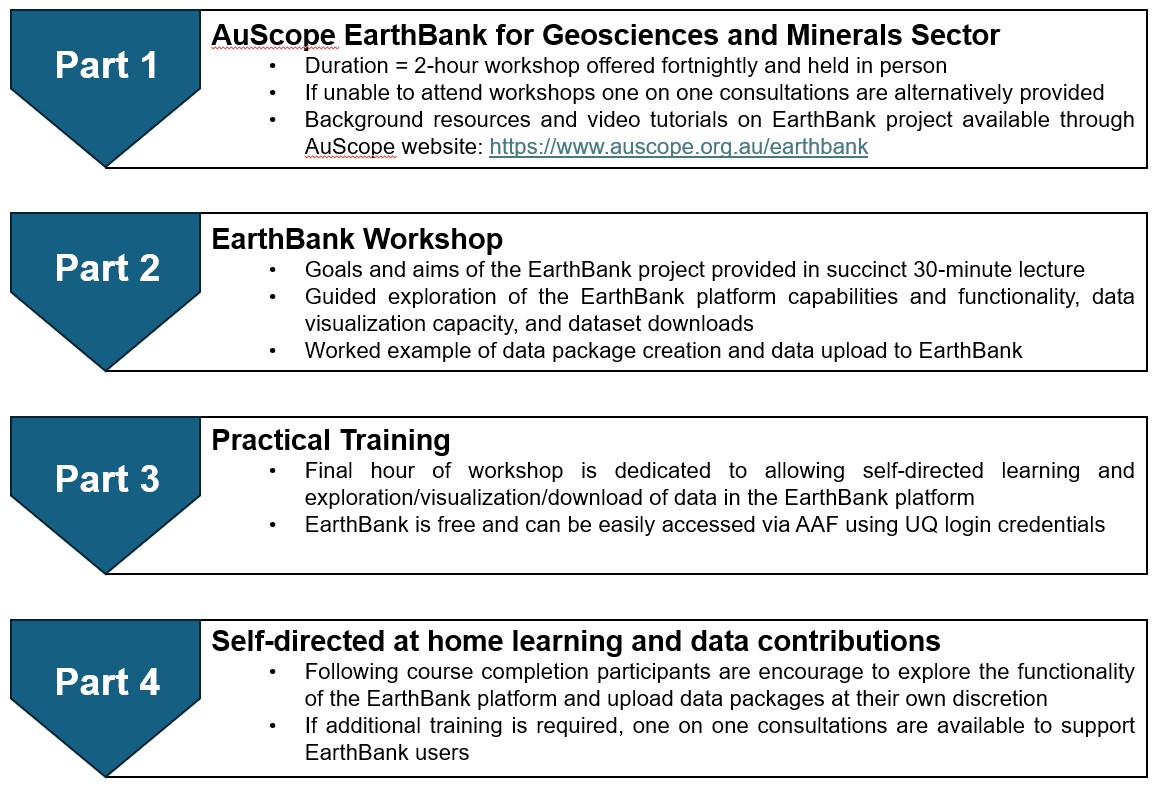
Part 1: Goals and Aims of the EarthBank Workshop
Time: Please see workshop dates online. Workshops are offered fortnightly.
Location: Workshops will be held on the St. Lucia campus. Participants will be notified of workshop room location several days in advance of the workshop date. Those who cannot attend workshop sessions, one-on-one consultations will be provided upon request.
Total duration: ~2 hours; ~30 min lecture outlining EarthBank project followed by a 1.5-hour workshop exploring the functionality of the EarthBank platform. The workshop is free and access to EarthBank is free via Australian Access Federation (AAF) using UQ login credentials.
Viewing of the EarthBank website and associated tutorial videos is highly encouraged to ensure workshop participants are familiar with the EarthBank project.
Part 2: EarthBank Workshop
Following the ~30-minute lecture a guided exploration of the EarthBank platform in an informal setting is provided to all workshop participants. This portion of the workshop will involve worked examples that showcase:
- How to navigate the EarthBank platform (e.g., login, data package types, visualisation tools etc.)
- How to create specific geochemical data packages for uploading your own datasets.
- Mint IGSNs (unique sample identifiers) for samples within a data package.
- Step by step worked example demonstrating how to format and upload geochemical datasets onto the EarthBank platform.
- How to download existing datasets from the EarthBank platform.
- Demonstrate the functionality and capability of the visualisation tools available in EarthBank for research purposes.
Part 3: Practical Training
The final hour of the workshop is dedicated to self-directed learning allowing the participants to explore the capabilities, functionality, and visualisation tools within the EarthBank platform at their own pace.
Part 4: Self-directed Learning
Following the completion of the workshop participants are encouraged to continue their exploration of, and familiarity with, the EarthBank platform at their own discretion. Geochemistry data contributions through the creation of data packages to the EarthBank platform are entirely voluntary but highly encouraged.
If additional training is required, or issues with data upload and visualisation are encountered, one-on-one consultations and support are available to EarthBank users by emailing j.stirling@uq.edu.au or accessing EarthBank Workshops.