
Rigaku SmartLab thin-film and micro-diffraction XRD

Instrument ID: https://doi.org/10.48610/ada43ca
Description
X-ray diffraction can be used to investigate the crystalline structure of films and non-isotropic samples. Examples of such investigations include the determination of the orientation of crystallites at surfaces (e.g. in epitaxial growth experiments), grazing-incidence diffraction measurements from thin films and studying superlattice structures.
X-ray reflectometery (XRR) can be used to study non-crystalline layers on substrate materials to probe the nano-scale structure perpendicular to a surface of the substrate.
Microdiffraction is a technique which allows diffraction measurements to be carried out selectively on small areas. This method is essential for materials which are too small to be measured in a traditional X-ray diffraction beam or where mapping of the sample is required.
The Rigaku SmartLab is a highly versatile XRD instrument and which features a 9 kW Cu rotating anode source; a variety of collimation options including 2 and 4 bounce Ge-Monochromators for HRXRD and capillary optics for micro diffraction; a cryo-stream (capillary/transmission optics only) that allows XRPD measurements from ca. 90 K to 600 K; a 5 axis goniometer, a domed furnace (reflectance geometry) that allows XRPD measurements from ambient to 1100 °C; and a two-dimensional hybrid pixel array detector. It can be configured to carry out a wide range of experiments on a wide range of sample types including: XRR measurements, in-plane and out-of-plane GI diffraction, texture analysis, reciprocal space mapping, HRXRD, microdiffraction and 2D mapping of samples.
To determine if experiments and/or samples are suitable in this instrument it is recommended that you contact the instrument scientist.
The instrument’s specifications are:
• Geometry: 5-Axis Geometry
• Source: Cu anode, rotating 9kW
• Detector: HyPix-3000 Hybrid Pixel Array Detector
• Conditions: Atmosphere
• Setup: Anton-Paar DHS 1100 heating stage, cooling, Capillary stage, Mapping Stage,
• Analysis package: DiffracPlus EVA, TOPAS, Siroquant V4, HighScore
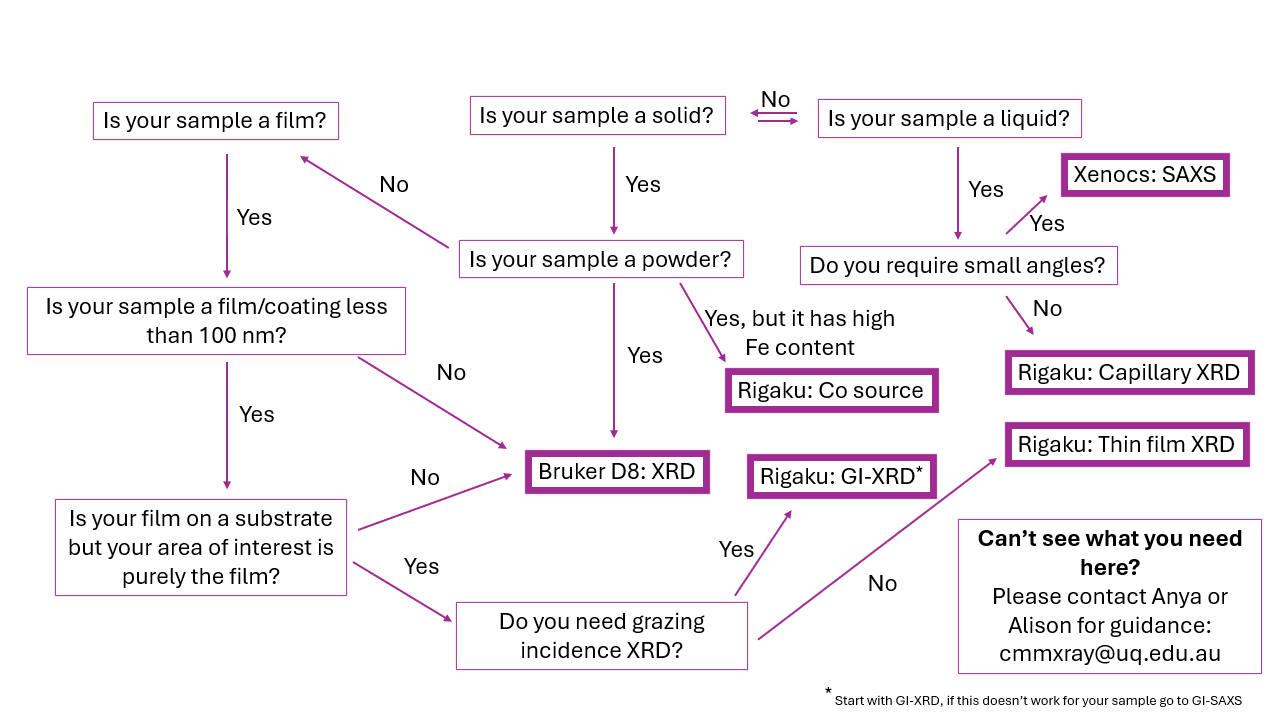
Is this the right instrument for you?
Use this flowchart to determine if the Rigaku Smartlab is the right instrument for your samples. If it is not, links to our other instruments can be found on the X-ray lab home page.
Location: Chemistry Building
Contact: Anya Yago; a.yago@uq.edu.au
Links:
Sample Identification Label - Large
Sample Identification Label - Small